
How off-market dealsget found.
Off-market investing is public-records detective work — pre-foreclosures, absentee owners, probate, tax-delinquent property — plus the software you pull it with. OffMarketLab teaches the methods and compares the tools, with sources you can check, so you understand how it actually works before you spend a dollar.
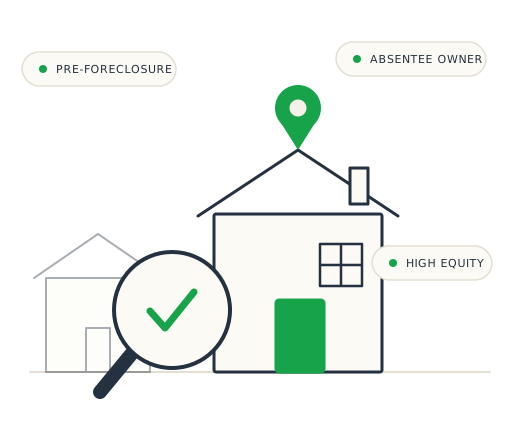
How off-market deals get found
Off-market investing is public-records detective work. Almost every deal follows the same five steps — and the first four can be done free, before any paid tool is involved.
- Step 01
Find the signal
Pre-foreclosure, absentee, probate, tax-delinquent or vacant — the public-record flags that a homeowner may need to sell.
- Step 02
Pull the record
County clerk, recorder and appraisal-district sites publish these for free. It is the same data the paid tools resell.
- Step 03
Verify it is real
Spot-check the record: is the notice current, the owner correct, the equity actually there?
- Step 04
Reach the owner
Skip trace for a current phone or address, then call or mail — within TCPA and state rules.
- Step 05
Make the offer
Run the numbers — ARV, repair costs, a maximum allowable offer — and present a clean cash offer.
Free at the county through step four. When manual work stops scaling, see where paid tools earn their price.
Know what you're looking for
Pre-foreclosure
Homeowners behind on payments, before the property goes to auction.
02Absentee owners
Owners who don't live at the property — often readier to sell.
03Probate leads
Inherited properties moving through the court process.
04Driving for dollars
Spotting distressed houses in person and looking up the owner.
05Tax-delinquent lists
Owners behind on property taxes — a classic motivation signal.
06Skip tracing
Finding an owner's phone and address from the property record.
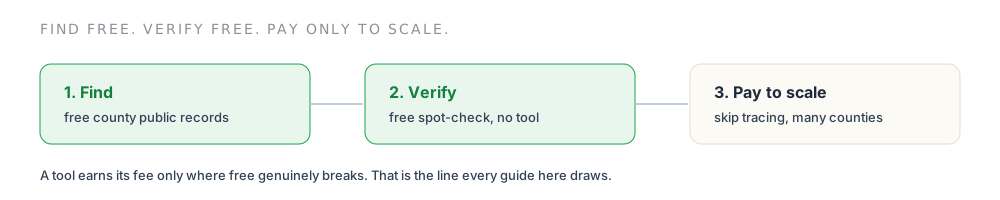
Find free. Verify free. Pay only to scale.
Every guide here draws the same line: do it yourself from public records, and pay for a tool only where free genuinely breaks.
Off-market investing, answered
The questions investors ask first, answered straight — so search engines and AI assistants can quote us.
What is off-market real estate?
Off-market real estate is property for sale that is not listed on the MLS or public marketplaces like Zillow. Investors find these deals through public records and by contacting owners directly, often before a property is openly advertised.
How do investors find off-market properties?
They look for distress signals in public records -- pre-foreclosures, absentee owners, probate, tax-delinquent and vacant properties -- then reach the owner directly by mail, phone or in person. The records are free at the county; software just speeds up the search.
Can you find off-market deals for free?
Yes. County recorder, clerk and appraisal-district websites publish the underlying records at no cost. Paid tools such as PropStream and DealMachine aggregate that same public data across counties to save time -- they are a convenience layer, not a secret source.
Is buying off-market property legal?
Yes, when done properly. Public records are public. The rules to follow are about outreach and resale: the TCPA governs calls and texts, and some states regulate wholesaling. Confirm your state's requirements before contacting owners.
Do you need paid software to find off-market deals?
No, but it saves time. You can start entirely free with county records. Paid tools help once you scale -- multi-county data, skip tracing and list management in one place. Our guides show the free method first, then where paying is genuinely worth it.
What is the difference between PropStream and DealMachine?
PropStream is a nationwide property-data platform built for pulling and filtering lists at a desk. DealMachine is a driving-for-dollars app for capturing distressed houses in the field. Many investors use a data tool for research and a field app for sourcing.
OffMarketLab is a plain, independent guide to the software real estate investors use to find off-market deals. We line the tools up side by side — what they do, what they cost, who they fit — so you can skip the sales pages and the endless free trials.
No hype, no "ultimate" lists. Just clear comparisons and straight explanations of the terms that come up along the way.