
How to Find Vacant Properties (Free Public-Records Method)
How to find vacant properties for free using county records, code enforcement, and visual signs -- plus the honest free-vs-paid math vendors skip.
You find vacant properties for free by combining four public signals: county assessor and tax records, code-enforcement citations, public utility shut-offs, and your own eyes on the street. No subscription is required to build the list. The address-level “USPS vacant list” most vendors imply you can buy does not exist for private investors — USPS gives that data to HUD only as aggregate counts, restricted to government and nonprofit users.
That gap between what is sold and what is actually free is the whole story below: the exact public-records workflow, how to qualify a vacant property to its owner, and the one place money is genuinely required.
What counts as a vacant property
A vacant property is one with no one living in or using it. That is distinct from abandoned, which adds owner intent — a property the owner has walked away from, often with unpaid taxes and code violations stacking up. Most vacant houses are not abandoned; the owner is an heir, an out-of-area landlord, or someone mid-move. The distinction matters because an abandoned property is far more likely to have a motivated — or absent — owner you will have to track down.
Vacancy is a signal, not a guarantee of a deal. A house can sit empty because it is between tenants or being renovated. The point of the workflow below is to find vacancy and then qualify it: pair the empty house with an owner who has a reason to sell.
Why vacancy is worth finding
Vacancy concentrates other distress signals in one place. A property nobody occupies tends to also be a property nobody is paying taxes on, maintaining, or insuring. The Center for Community Progress, a national nonprofit focused on vacant and abandoned property, puts it plainly: “No data point is more predictive of a potential problem property than property tax delinquency” (Center for Community Progress, verified June 2026). Vacant houses cluster with delinquency, code violations, and dead utilities — which is exactly why a free, multi-source approach beats any single list.
For how vacancy sits next to the related signals, see the companion guides on absentee owners, probate leads, and tax-delinquent properties.
The free public-records method, step by step
This is the part list-sellers compress into a single line. None of it requires a paid tool.
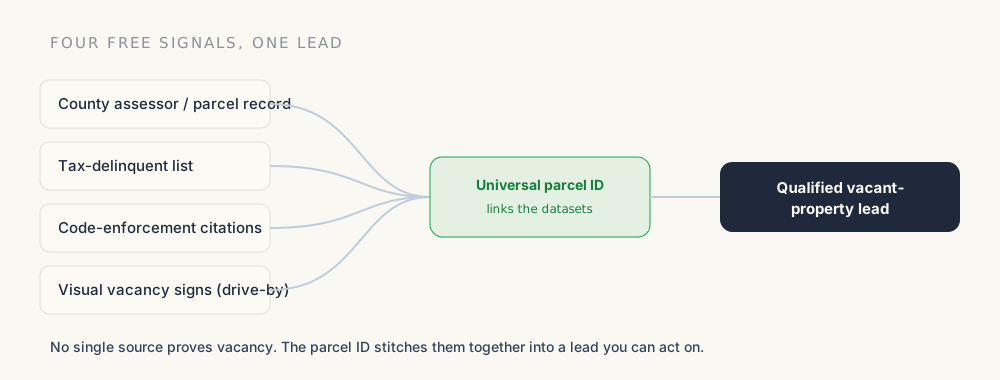
1. Start at the county assessor. The assessor (or appraisal district) holds the parcel record for every property: owner name, mailing address, assessed value, and the parcel ID. That parcel ID is the key that links every other dataset together — the Center for Community Progress calls it a “universal parcel identifier…that can be used to link and merge separate datasets managed by different departments” (Center for Community Progress, verified June 2026). If the owner’s mailing address differs from the property address, you may have an absentee owner — a vacancy lead in itself.
2. Pull the tax-delinquent list. Counties publish lists of owners behind on property taxes, usually free at the treasurer or tax collector’s office. Because delinquency is the strongest single predictor of a problem property, cross-referencing it against vacancy signs is the highest-yield pairing you can make. Full click-path in the tax-delinquent guide.
3. Search code-enforcement records. Many municipalities post code-enforcement citations online. Recurring, unremedied violations are a strong vacancy tell — the Center for Community Progress lists “recurring, unremedied, and unpaid citations” as indicators of property condition (Center for Community Progress, verified June 2026). A property cited repeatedly for overgrowth or an open structure, with nothing fixed, is usually empty.
4. Check public utility records where available. Some jurisdictions treat water and other utility records as public. Service shut off, or “significant usage drops for six months or more,” flags likely vacancy (Center for Community Progress, verified June 2026). Availability varies widely by locality, so treat this as a bonus source, not a guaranteed one.
5. Find the portals fast. You do not need to memorize every county’s site. NETROnline’s Public Records Online Directory indexes assessor, recorder, and treasurer portals county by county, free, so you can locate the right page in any US county in a minute. This is the same public-records foundation our methodology is built on.
Reading the street: visual vacancy signs
Records tell you who and how much; the drive-by confirms empty. This is driving for dollars applied to a records list — not a substitute for it.
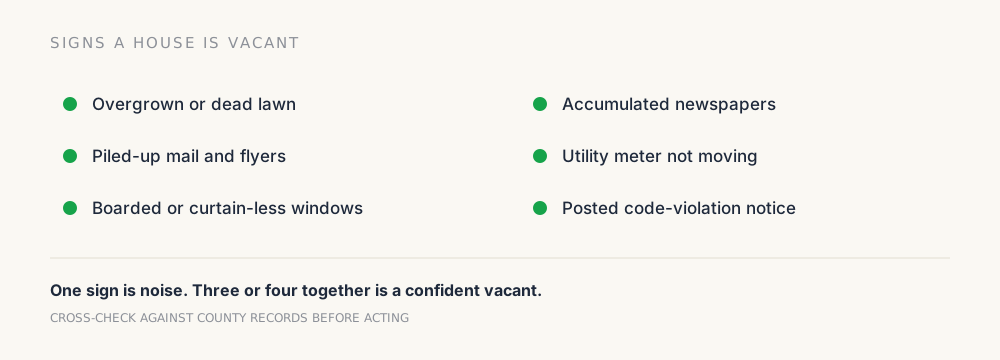
The reliable tells: an overgrown or dead lawn, mail and flyers piling up, newspapers accumulating, windows that are boarded, curtain-less, or permanently dark, no vehicles over repeated visits, and any posted code-violation or vacant notice on the door. One sign means little; three or four together is a confident vacant. Full field method in driving for dollars.
Treat every visual read as a hypothesis to confirm against the county record. A house can look vacant and be mid-renovation, and a tidy house can be empty. The records are the proof; the street is the filter.
Finding the owner of a vacant property
Once a parcel is flagged vacant, the assessor record already gives you the owner’s name and mailing address — free. For a clean vacancy, that is often enough to send mail.
The harder case is the abandoned property whose owner has moved on, where the mailing address is stale or the owner is deceased and the property is in probate. Here you trace through the chain of public records: the recorder of deeds for the last recorded transfer and any liens, probate court if the owner has died, and the same NETROnline portal index to find each office. Most owners are findable through free records alone if you are willing to do the cross-referencing by hand.
Free vs paid: the honest math
This is where vendor blogs go quiet. Almost everything above is genuinely free. The paid tools resell the same public records, plus two things the free method cannot do at scale.
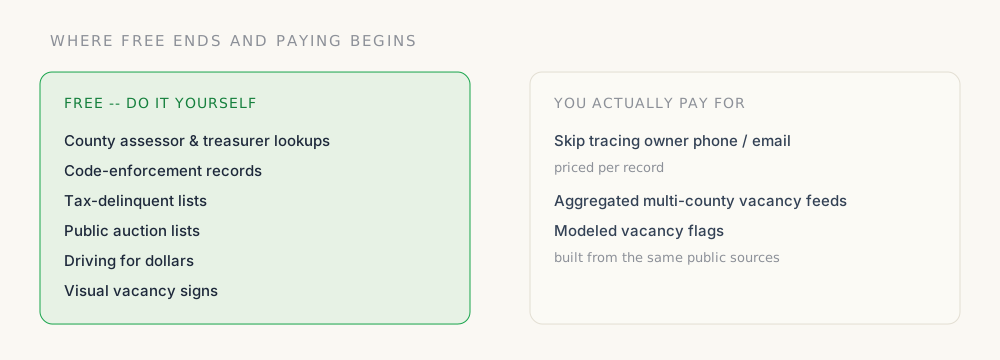
Free, by hand: county assessor and treasurer lookups, code-enforcement records, tax-delinquent lists, public auction lists, driving for dollars, and visual vacancy signs. For one county, a few hours a week, this wins.
Genuinely worth paying for: skip tracing (appending owner phone and email is priced per record and does not scale by hand) and aggregated multi-county vacancy feeds (pulling and normalizing records across dozens of counties is a part-time job). What you are buying in those feeds is a vendor’s modeled vacancy flag built from the same public sources — not a secret list.
Which brings us to the myth worth killing. Many guides imply you can simply download “the USPS vacant address list.” You cannot. USPS supplies its address-vacancy data to HUD as aggregate counts — not a list of individual addresses — and HUD states it “can make the data accessible only to governmental entities and non-profit organizations registered as users” (HUD USER, USPS Vacancy Data, verified June 2026). When a tool markets “USPS vacancy data,” it is selling its own modeled flag, not the postal list.
Run the numbers before subscribing: estimate the qualified vacant leads a county yields in a month, value the hours to pull them, and compare to the list price. One county usually favors free; many counties, or phone numbers at volume, usually favor paying. We keep tool comparisons neutral on the compare page — there is no list for sale here.
Frequently asked questions
How do I find vacant properties for free? Combine free public records with your own observation: pull the county assessor’s parcel records, the tax-delinquent list, and code-enforcement citations, check utility records where they are public, then confirm on the street with visual signs. Property tax delinquency is the single most predictive signal of a problem property (Center for Community Progress, verified June 2026).
Can I get the USPS list of vacant addresses? No. USPS provides its vacancy data to HUD as aggregate counts, not as a list of specific addresses, and HUD states the data is accessible “only to governmental entities and non-profit organizations registered as users” (HUD USER, verified June 2026). Tools advertising “USPS vacancy data” sell a modeled vacancy flag, not the postal list.
What is the difference between a vacant and an abandoned property? Vacant means unoccupied. Abandoned adds owner intent — the owner has walked away, usually with unpaid taxes and stacking code violations. Most vacant houses are not abandoned, and abandoned ones are harder because the owner is, by definition, absent.
How do I find the owner of a vacant property? Start with the county assessor record, which lists the owner name and mailing address free. For abandoned or inherited properties, trace through the recorder of deeds and probate court using a portal index like NETROnline. Most owners are reachable through free public records with manual cross-referencing.
What are the signs that a house is vacant? Overgrown or dead landscaping, piled-up mail and newspapers, boarded or permanently dark windows, no vehicles over repeated visits, and posted code-violation or vacant notices. Public utility records showing service shut off or a six-month-plus usage drop are a strong records-based confirmation (Center for Community Progress, verified June 2026).
Sources
- Center for Community Progress — Finding Vacant and Abandoned Properties — tax delinquency as the top predictor, code-enforcement and utility indicators, and the universal parcel identifier (verified June 2026)
- HUD USER — USPS Vacancy Data — USPS sends HUD aggregate vacancy counts of addresses vacant 90 days or longer; access limited to registered governmental entities and non-profit organizations (verified June 2026)
This article is structured desk research: public records and primary government and nonprofit sources, cited and dated. It is not legal advice. Records access, utility-record disclosure, and outreach rules vary by state and county; verify the rules for your jurisdiction.