
Skip Tracing for Real Estate: The Honest Guide
Skip tracing for real estate without the hype: the free public-records path, when paid skip tracing is worth it, and the FCRA and DPPA rules that actually apply.
Skip tracing for real estate is the process of finding a property owner’s current contact details — usually a phone number — when public records only give you a name and a mailing address. Investors use it to call or text owners of off-market houses. The part vendors skip: free county records already hand you the owner’s name and mailing address, which is enough to mail them. Skip tracing only fills the phone-number gap, and only that gap is worth paying for.
Below is the free public-records path step by step, the honest free-versus-paid math, and the compliance reality that contradicts the “skip tracing is 100% legal” line you will read everywhere else.
What skip tracing actually is
Skip tracing started as a term for locating people who “skipped” town — debtors, bail jumpers, missing heirs. In real estate it means the same mechanical thing: you have a property and an owner name, and you need a way to reach that person. The county recorder and assessor will give you the owner of record and a mailing address for free. What they almost never give you is a current cell phone number, because owners do not file their phone numbers with the county.
That single missing field is the whole skip-tracing industry. A skip-tracing service matches an owner’s name and known address against aggregated data — phone carrier records, credit-header data, public filings, marketing databases — and returns likely phone numbers and emails. It is an append step, not magic. The accuracy depends entirely on how good the input is and how fresh the underlying data is.
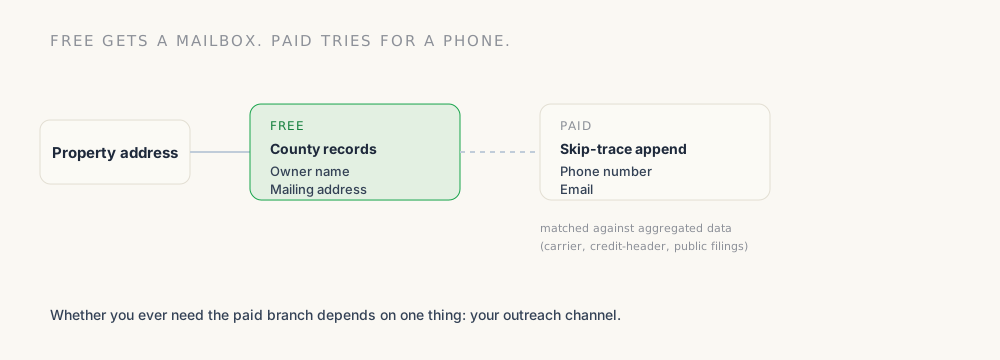
The distinction that matters most: free public records reliably get you to a mailbox. Paid skip tracing tries to get you to a phone. Whether you need the phone at all depends on how you plan to reach owners — and that decides whether you ever need to pay.
Why it matters for off-market deals
Off-market acquisition is a contact game. You find a distressed or absentee-owned property — through absentee-owner records, a tax-delinquent list, probate, or driving for dollars — and then you have to actually reach the owner before anyone else does. The lead is worthless if you cannot make contact.
There are two ways to make contact, and they need different data:
- Direct mail needs a name and a current mailing address. County records plus an address-cleaning step give you this for free or near-free.
- Cold calling or texting needs a phone number. This is the field county records do not have, and it is the only reason to skip trace.
Most beginner guides treat skip tracing as a mandatory first step. It is not. It is mandatory only if your outreach channel is the phone. Decide the channel first; the data spend follows from it.
The free public-records method, step by step
This is the path vendor blogs bury, because teaching it cannibalizes their per-record fees. It gets you to a mailable lead for $0.
1. Find the right county portal. Records live with the county, and every county is different. Use the free NETROnline public-records directory to jump straight to the correct county Assessor, Treasurer, and Recorder pages for any address; it is a directory of official portals, not the records itself, and coverage varies by county (NETROnline, verified June 2026).
2. Pull the owner from the assessor. The county assessor or appraisal district maps a property to its owner of record and a mailing address, free. In our showcase county, the Harris Central Appraisal District lets you search real property by address, account, or owner name at no charge (HCAD, verified June 2026). That search returns the name to address your mail to.
3. Confirm and enrich at the recorder. The county recorder or clerk holds the recorded documents — deeds, mortgages, liens. The grantor/grantee index confirms who currently holds title and surfaces whether there is a mortgage or other lien, which tells you about equity. Many of these offices publish online; NETROnline links you to each one.
4. Read the mailing address for the absentee signal. If the owner’s mailing address is different from the property address, the owner does not live there. That is the absentee signal, and it both qualifies the lead and tells you exactly where a letter will land.
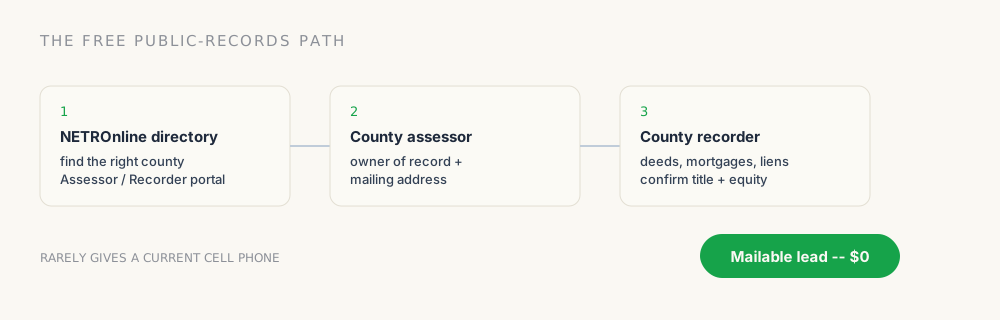
Be honest with yourself about what this produces. The free path reliably yields a name and a mailing address — a complete direct-mail lead. It will not produce a current cell phone. A note on jurisdiction: what owner detail appears online varies by state and county — some portals publish the owner name and mailing address, others omit the name. Georgia, for example, provides free statewide property-record search portals with owner name and address (Georgia Department of Revenue, verified June 2026). Check your own county before assuming a field will be there.
Cross-referencing and qualifying before you spend
Skip tracing a bad list is how you waste money. The append fee is per record whether the lead is good or not, so qualify first, append second.
Stack the free signals before deciding which records are worth a phone number:
- Absentee status — mailing address differs from the property address.
- Equity — assessed or market value against any recorded mortgage and liens in the recorder’s index.
- Distress — the record sits on a tax-delinquent, pre-foreclosure, or probate list, or you flagged the house from the road.
A lead that hits two or three of those is worth pursuing. A lead that hits none probably is not, no matter how clean its phone number turns out to be. This pre-screen is the same public-records cross-check our methodology is built on, and the terms are defined in the learn hub. Doing it by hand is slow but free; doing it at volume is exactly what paid platforms automate.
The compliance truth vendors will not tell you
The single most common claim in this niche is that skip tracing is “100% legal.” That is too clean. Skip tracing is legal if you stay inside specific federal lines, and the lines are real.
FCRA: your purpose probably is not on the list. The Fair Credit Reporting Act restricts who can pull a “consumer report” to a closed list of permissible purposes — a court order, the consumer’s own written instructions, credit, employment, insurance underwriting, government benefits, account review, and a legitimate business need tied to a transaction the consumer initiated (15 U.S.C. 1681b, verified June 2026). Cold outreach to buy someone’s property is not on that list, and the owner did not initiate anything. The practical consequence: compliant real-estate skip tracing must use data that is not a regulated consumer report — so reputable services pull from non-FCRA sources and bar using their data for credit, employment, or tenant decisions. If a vendor will not say which side of FCRA its data sits on, that is a flag.
DPPA: motor-vehicle records are off-limits for contact. The Driver’s Privacy Protection Act bars state DMVs and their contractors from disclosing personal information from motor-vehicle records except for enumerated uses; research use is allowed only “so long as the personal information is not published, redisclosed, or used to contact individuals” (18 U.S.C. 2721, verified June 2026). Translation: you cannot use DMV data to contact a property owner. Period.
TCPA: governs the call you make next. Once you have the number, the Telephone Consumer Protection Act and state calling rules govern how you may use it — consent requirements, calling-time windows, and do-not-call obligations (47 U.S.C. 227, verified June 2026). Skip tracing returns a number; it does not grant permission to autodial it.
The takeaway is not “do not skip trace.” It is that the honest version of the legality answer is conditional, and a site with no skip-trace product to sell can say so plainly.
Paid versus free: the honest math
The “free skip tracing” tools you will find in search results are mostly lead-magnet hooks — a small monthly allotment of free credits, then a paywall. Genuinely free skip tracing at volume does not exist, because the underlying data costs money to license. So the real decision is not free-tool-versus-paid-tool. It is free-public-records-for-mail versus paid-append-for-phone.
Here is the honest split:
- Use the free public-records path when your channel is direct mail, when you work one county, and when your volume is low enough to pull and cross-reference by hand. County records plus a cleaned mailing list is a legitimate $0-to-cheap route to every owner you found.
- Pay for skip tracing when your channel is cold calling or texting, when you work many counties at once, or when your list is too long to enrich by hand. Paid append is priced per record and earns its fee precisely where the manual path breaks: phone numbers at scale.
Whichever channel you choose, mail to a current address. Run mailing lists through USPS NCOALink, the postal service’s secure dataset of roughly 160 million permanent change-of-address records, updated weekly, that mailers use to update addresses before they mail (USPS PostalPro, verified June 2026). That one cheap step prevents wasted postage on owners who have moved — and it is the closest thing to “free skip tracing” that actually works, because it fixes the address you already have rather than guessing at a phone number you do not.
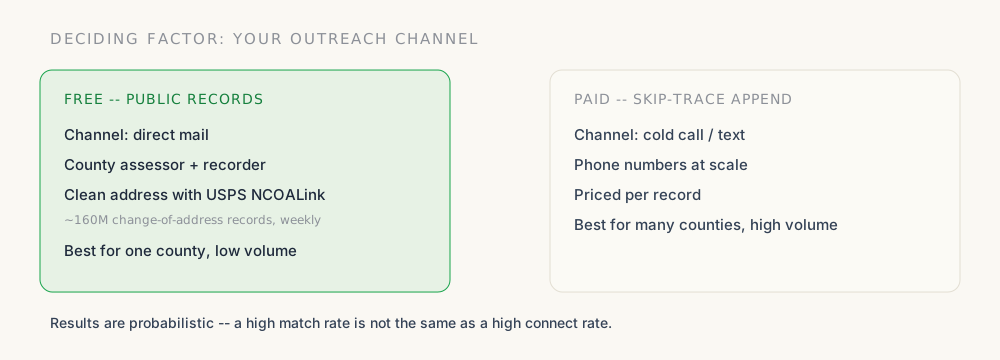
One more honesty note on accuracy. Skip-tracing results are probabilistic, not certain. A service can return a number for most records (a high match or “hit” rate) while a much smaller share of those numbers actually reach the right person (the connect rate), and the two are not the same. Treat any vendor’s headline hit-rate number as the optimistic end. We keep tool-by-tool breakdowns tool-neutral on the compare page — there is no skip-trace product for sale here, which is exactly why this guide can tell you when not to buy one.
Frequently asked questions
What is skip tracing in real estate? Skip tracing is the process of finding a property owner’s current contact information — typically a phone number or email — by matching their name and known address against aggregated data sources. Investors use it to reach owners of off-market or distressed properties when county records only provide a name and a mailing address.
Is skip tracing legal? It is legal if you stay inside federal rules, not unconditionally. The FCRA limits pulling consumer reports to a closed list of permissible purposes that does not include cold property outreach (15 U.S.C. 1681b), so compliant data must come from non-FCRA sources. The DPPA bars using motor-vehicle records to contact people (18 U.S.C. 2721), and the TCPA governs the calls and texts you make afterward.
How do I skip trace a property owner for free? Pull the owner’s name and mailing address from the county assessor or appraisal district, confirm title and liens at the county recorder, and use the NETROnline directory to find the right portals (NETROnline). That gets you a complete direct-mail lead free. It will rarely produce a current cell phone, which is the gap paid skip tracing fills.
Can I find a property owner’s phone number for free? Usually not reliably. County records give you a name and mailing address but not a phone number, because owners do not file phone numbers with the county. The “free skip tracing” tools in search results are typically small free-credit allotments before a paywall. The legitimate free play is direct mail to a current address, not a free phone number.
What is the difference between hit rate and accuracy in skip tracing? Hit rate is the share of records a service returns any contact data for. Accuracy — often measured as the connect or right-party rate — is the share of those that actually reach the correct person. A list can have a high hit rate and still low accuracy, so judge a service on whether the numbers reach the owner, not on how many rows came back filled.
Sources
- 15 U.S.C. 1681b — Permissible purposes of consumer reports (Cornell LII) — FCRA closed list of permissible purposes (verified June 2026)
- 18 U.S.C. 2721 — Prohibition on release of personal information from state motor vehicle records (Cornell LII) — DPPA contact restriction (verified June 2026)
- 47 U.S.C. 227 — Restrictions on use of telephone equipment (Cornell LII) — TCPA calling and consent rules (verified June 2026)
- USPS PostalPro — NCOALink — ~160 million change-of-address records, updated weekly (verified June 2026)
- NETROnline — Public Records Online Directory — free directory of county assessor, treasurer, and recorder portals (verified June 2026)
- Harris Central Appraisal District (HCAD) — free property search by address, account, or owner name (verified June 2026)
- Georgia Department of Revenue — Property Records Online — free statewide property-record search portals (verified June 2026)
This article is structured desk research drawing on federal statutes and primary government sources, cited and dated. It is not legal advice. FCRA, DPPA, and TCPA obligations and records access vary by jurisdiction and change over time; verify the current rules for your state and county before you skip trace or make contact.