
US Housing Market Forecast 2026: The 0% Year
The 2026 US housing market forecast points to 0% national price growth and ~6.3% mortgage rates, with a Sun Belt glut. What a flat year means for off-market investors.
The 2026 US housing market forecast is, in a word, flat. J.P. Morgan projects 0% national home-price appreciation, mortgage rates are expected to hold near 6.3%, and the national number hides a sharp regional split — a Sun Belt inventory glut against a tighter Midwest. For an off-market investor the takeaway is blunt: appreciation will not rescue a thin deal in 2026, so the margin has to come from the buy.
The 0% year, in plain numbers
J.P. Morgan’s securitized-products research team, led by John Sim, expects national home prices to “stall at 0%” in 2026 after nearly doubling over the prior decade, with a small demand improvement roughly cancelling a supply uptick (J.P. Morgan, forecast published January 2026). It is the cautious end of the range — Morgan Stanley, for contrast, projects about 2% for 2026 (Morgan Stanley). Either way, the era of double-digit equity gains is over for now.
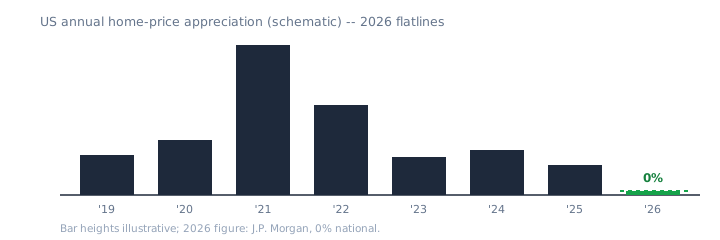
That is the single most important line in any US housing market forecast 2026: the market is not crashing and it is not lifting. It is holding still.
Rates settle, they do not fall
The other half of the stasis is financing. Fannie Mae’s 2026 forecast puts the 30-year fixed rate at roughly 6.3% on average through the year (the Mortgage Bankers Association is a touch higher at 6.5%) (Fannie Mae). Relief is not the base case. Navigating 6.3% average mortgage rates means underwriting deals at today’s cost of money, not a hoped-for refinance — if a lower rate arrives later, treat it as upside, never as the plan.
The regional split the headline hides
A 0% national figure is an average of very different local markets. The pain is concentrated in the Sun Belt, where aggressive 2023-2024 construction left Florida, Texas, and Arizona with excess new inventory (Fortune). The Midwest is the mirror image — tighter supply, low new construction, and more durable affordable price points (Forbes).
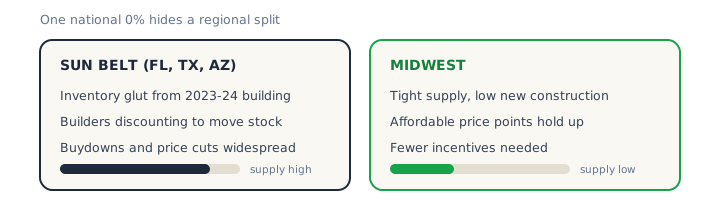
The builder response tells the story: roughly 67% of builders were offering incentives and about 40% were cutting prices outright as inventory backed up (NAR).
Builder rate buydowns: manufactured affordability, with a catch
The signature tactic of the glut is the builder rate buydown. In a common 2-1 buydown, the builder pre-pays points so the buyer’s effective rate is about two points lower in year one and one point lower in year two before reverting to the note rate (Movement Mortgage). Builder rate buydowns are the defining Sun Belt 2026 lever — they make the monthly payment feel affordable from day one.
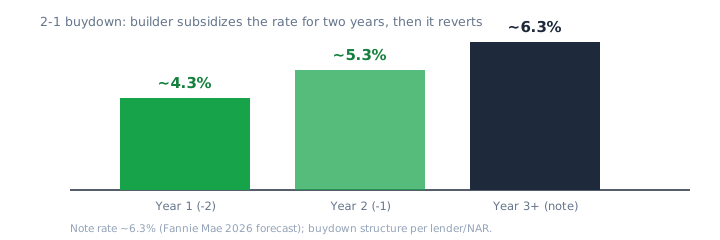
The catch: a buydown lowers the payment, not necessarily the price. Analysts have documented that permanent buydowns can prop up new-home sticker prices, because the incentive gets funded by keeping the price high (AEI). Before taking one, check the home against independent comps (Kiplinger). A cheap payment on an inflated price is not a discount.
What a flat market means for off-market investors
Here is where the forecast stops being macro trivia and becomes strategy. When appreciation is 0%, buying at retail and waiting is a dead plan — there is no tailwind. The return has to be built into the purchase. That is the entire premise of off-market investing, and it is exactly why a flat year favors it.
The durable 0% home price appreciation strategies are the unglamorous ones:
- Buy below market off-market. A discount at acquisition is locked-in return that does not depend on the market moving. Distressed, motivated-seller situations — pre-foreclosure, absentee owners, probate — are where those discounts live, and the records are public. The free method is in where pre-foreclosure data comes from.
- Force appreciation. Value-add (renovation, better management, higher-and-better use) creates equity you manufacture rather than wait for.
- Underwrite to the buy, not the exit. With rates near 6.3% and prices flat, the deal has to work on day-one numbers. Our methodology is built on verifying every input against its primary source rather than trusting a projection.
A rising market forgives a mediocre entry. A 0% market does not. In 2026 the buy is the whole game.
Sources
- J.P. Morgan — US Housing Market Outlook (0% 2026 forecast; accessed July 2026)
- Fortune — JPMorgan’s nationwide forecast hides a Sun Belt full of pain (regional divergence; accessed July 2026)
- Morgan Stanley — mortgage rates forecast 2025-2026 (2% 2026 contrast; accessed July 2026)
- Fannie Mae — Forecast (6.3% rate; accessed July 2026)
- NAR — Builders Are Sweetening the Deal (incentive prevalence; accessed July 2026)
- Movement Mortgage — new-construction builder incentives (2-1 buydown mechanics; accessed July 2026)
- AEI — permanent rate buydowns prop up new-home prices (buydown caveat; accessed July 2026)
- Kiplinger — hidden costs of builder mortgage incentives (buyer caution; accessed July 2026)
- Forbes — 10 predictions for homebuilding and rental housing (Midwest outperformance; accessed July 2026)