
US Tariffs and Canadian Real Estate in 2026
How US tariffs are pressuring Canadian real estate: rising build costs, a weak condo market, the pivot to purpose-built rentals, and fixed vs variable renewal strategy.
US tariffs are adding cost and uncertainty to Canadian real estate at an already fragile moment. Section 232 duties — 50% on steel and aluminum, 10% on softwood lumber on top of existing duties — are squeezing Canadian sawmills and raising build costs on both sides of the border, while the condo market has stalled and capital pivots toward purpose-built rentals. For most owners the pressing question is narrower: at renewal, fixed or variable?
The tariff drag
The impact of US tariffs on Canadian real estate runs through construction inputs. As of 2026, US Section 232 tariffs sit at 50% on steel and aluminum, 10% on softwood lumber (atop existing antidumping/countervailing duties averaging 8-9%), and 50% and 30% on kitchen cabinets and wood furniture (NAHB).
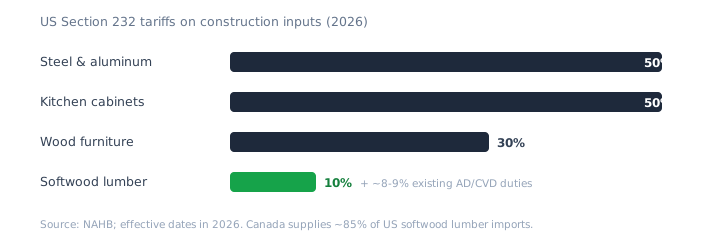
The effect is two-sided. Canada supplies roughly 85% of US softwood lumber imports, so the duties are curtailing Canadian sawmill output — with historic losses and some permanent closures (Canadian Mortgage Professional) — while also lifting North American build costs. Statistics Canada’s Building Construction Price Index rose 4.2% year-over-year in Q3 2025, led by metal fabrications (Business Data Lab). On top of that, the broader trade uncertainty is itself weighing on housing demand (CMHC).
The weak Canadian condo market
The clearest casualty is the pre-construction condominium. CMHC’s outlook has condo construction “especially weak,” with national starts set to decline through 2026-2028 as developers face high costs, softer demand, and elevated inventory (CMHC). The weak Canadian condo market has pushed investor appetite for speculative pre-construction units to a standstill.
On affordability, be precise: condo prices and carrying costs have eased from their peak as rates come down, which helps buyers at the margin — but CMHC is blunt that Canada remains far from healthy affordability, estimating 430,000-480,000 new homes are needed annually through 2035 to restore 2019 affordability, nearly double the current pace (CMHC). “Cheaper than the peak” is not the same as “affordable.”
The pivot to purpose-built rentals
Capital does not sit still; it moves to the path of least resistance. With condos stalled, developers are shifting to dedicated rental supply. The purpose-built rental apartment starts vs condos 2026 picture is a clean divergence: rental construction is surging and propping up total starts while condo builds fall sharply (CMHC).
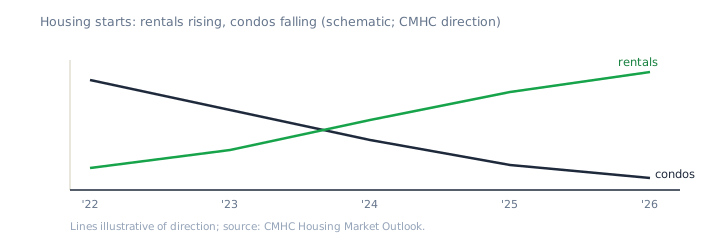
The wave is real enough to give tenants more choice in some markets (Globe and Mail) — though analysts caution the rental boom is not, by itself, closing the structural shortage. The mix is changing faster than the total.
The renewal wall: fixed vs variable
For existing owners, the tariff-and-macro story lands as a renewal problem. A large share of borrowers took mortgages when the Bank of Canada’s policy rate was at or below 1%, and they are renewing into materially higher payments (Mortgage Sandbox).
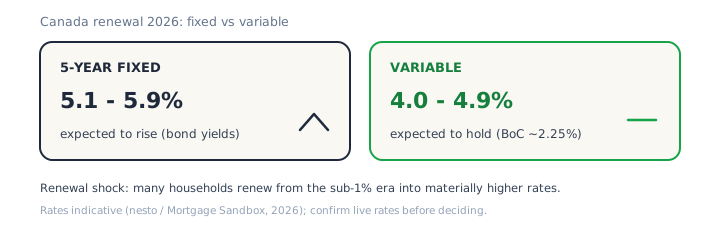
The variable vs fixed mortgage renewal strategies Canada decision comes down to how the two rates are set. Most of the Big Six expect the Bank of Canada to hold its policy rate near 2.25% through much of 2026, though a couple see upside risk (nesto). Fixed rates move first, on bond-market expectations, and are generally expected to drift higher; variable rates track the Bank’s policy rate and are expected to hold (Mortgage Sandbox).
There is no universal answer, and anyone who gives you one is guessing:
- Variable (roughly 4.0-4.9%) offers near-term savings if the Bank holds or cuts — at the cost of payment uncertainty.
- Fixed (roughly 5.1-5.9%) buys certainty and caps your downside if rates rise — at a higher starting payment.
The honest framing is the same one we apply to every market claim: decide on your own renewal timing, cash-flow tolerance, and verified current rates — not on a forecast delivered with false confidence. (For the parallel US picture, see our US housing market forecast 2026; the disciplined stance in both markets is our methodology: verify inputs, distrust certainty.)
Sources
- NAHB — how tariffs impact home building (Section 232 tariff rates; accessed July 2026)
- Canadian Mortgage Professional — tariffs gutting Canadian lumber mills (sawmill impact; accessed July 2026)
- Business Data Lab — building trouble: US tariffs on Canadian construction materials (StatCan BCPI, ~85% lumber share; accessed July 2026)
- CMHC — Housing Market Outlook (condo weakness, rental surge, 2019 affordability target; accessed July 2026)
- Globe and Mail — purpose-built rentals give tenants an edge (rental wave; accessed July 2026)
- Mortgage Sandbox — Canada mortgage rate forecast 2026-2028 (fixed vs variable outlook, renewal shock; accessed July 2026)
- nesto — mortgage rates forecast Canada (Bank of Canada rate path; accessed July 2026)