
How to Get Real Estate Comps Without MLS Access
Free comps from county records, what they miss, and the 10-plus non-disclosure states where sale prices are not public record at all. Verified July 2026.
You can pull real estate comps without MLS access from two free sources: your county’s recorded sales data, and consumer estimate sites like Redfin and Zillow. Both have honest limits nobody mentions. The consumer estimates are built on MLS data you do not have, and their accuracy roughly quadruples in error on off-market homes — the exact homes investors care about. And in about ten states, including Texas, sale prices are not public record at all, which breaks the county method entirely.
This is the article that tells you where the free method stops working, because every other version of it stops at “just check your county assessor.”
The uncomfortable part: the free tools run on the data you lack
The standard advice is to use Zillow or Redfin instead of the MLS. Read what those tools actually are.
Redfin says plainly that its estimate uses “complete and direct access to multiple listing services (MLSs), the databases that real estate agents use to list properties,” covering 92 million homes (Redfin, verified 2026-07-16). So a free Redfin estimate is not an alternative to the MLS. It is an MLS-derived number that Redfin licensed and gave you for free, rounded off.
That is fine, as long as you know what you are holding. You are not escaping the MLS. You are borrowing someone else’s copy of it.
The accuracy gap that should actually worry an investor
Here is the number that matters, and it is on Redfin’s own page:
- On-market homes: median error 1.85%
- Off-market homes: median error 7.25%
(Redfin, verified 2026-07-16.)
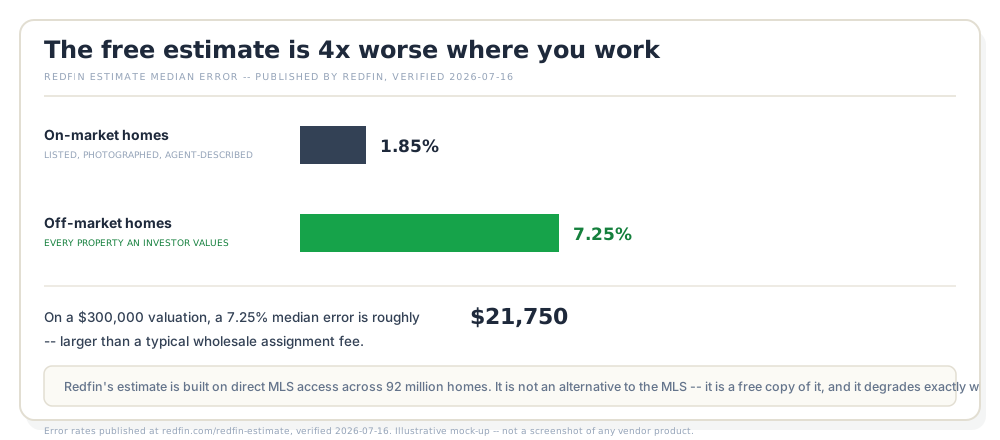
Read that against what you do for a living. If you are buying off-market, every property you value is in the 7.25% bucket. The tool is roughly four times less accurate precisely where you operate, because an off-market house has no recent listing, no photos, and no agent-entered condition notes to learn from.
On a $300,000 valuation, 7.25% is about $21,750 of error. That is larger than most wholesale assignment fees. A comp set you would not bet $21,750 on is not a comp set; it is a starting point.
The free method that actually works: recorded sales
The genuinely free, genuinely independent source is your county. When a property sells, the deed is recorded with the county recorder or clerk, and in most states the sale price is recorded with it or reported to the assessor. That is a public record, it is free, and it is the same underlying event the MLS reports.
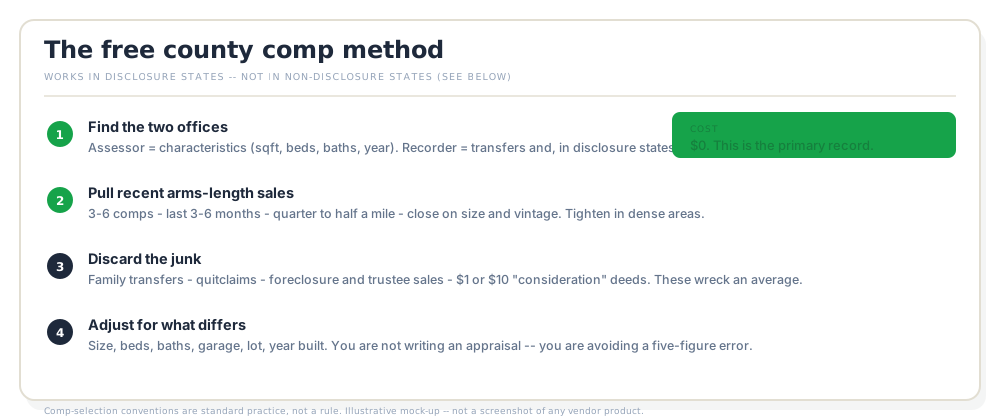
The method:
- Find your county’s property search. Search for your county assessor or appraisal district, and separately for the county recorder or clerk. The assessor holds characteristics (square footage, beds, baths, year built); the recorder holds the transfer and, in disclosure states, the price.
- Pull recent arms-length sales near the subject. Convention is 3 to 6 comparable sales within the last 3 to 6 months, within a quarter to half a mile, and close on size and vintage. Tighten the radius in dense areas and loosen it in rural ones.
- Discard the junk. Family transfers, quitclaims, foreclosure and trustee sales, and $1 or $10 “consideration” deeds are not market comps. They will wreck your average if you leave them in.
- Adjust for what differs. Size, bed and bath count, garage, lot, and year built. You are not writing an appraisal; you are trying not to be wrong by five figures.
This costs nothing and it is not a copy of anyone’s MLS. It is the primary record.
Where the free method breaks: non-disclosure states
Now the part the other guides skip.
In a non-disclosure state, the sale price is not public record. The deed transfers, the sale happens, and the price simply is not published. No county portal will give it to you, because nobody is required to file it.
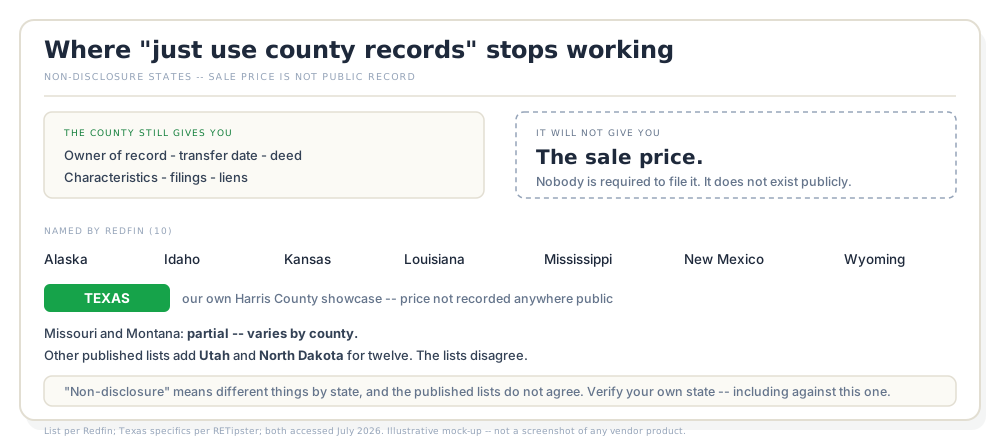
Redfin names ten: Alaska, Idaho, Kansas, Louisiana, Mississippi, Missouri, Montana, New Mexico, Texas and Wyoming, and notes Missouri and Montana are partial, varying by county (Redfin, accessed July 2026). Texas is the clearest case: “Sales prices are not listed in any publicly recorded documents nor is the sales price shared with a governmental agency” (RETipster, accessed July 2026).
Two honest caveats. First, the published lists disagree — some add Utah and North Dakota, giving twelve. Second, “non-disclosure” means different things in different places: sometimes the price never reaches the assessor, sometimes it reaches the assessor but is withheld from the public, sometimes reporting it on the deed is merely optional (RETipster). Verify your own state rather than trusting any list, including this one.
Note what this means for us specifically. Harris County, Texas is our public-records showcase, and it is excellent for ownership, filings and characteristics — but it will not tell you what the house next door sold for. A guide that says “just use county records for free comps” has never tried it in Texas.
What to do in a non-disclosure state
There is no free lunch here, and anyone selling you one is guessing. The realistic options:
- Assessed values, which exist but track market value loosely and lag.
- Active list prices, discounted — but a discount off an asking price is an assumption, not a comp.
- An agent relationship. Someone with MLS access can legally pull sold data. This is why investors in Texas cultivate an agent.
- Licensed data. The paid platforms buy MLS and public-record feeds and resell them to you.
RETipster suggests estimating from active listings discounted 20-25% or referencing assessed values, while acknowledging assessed values “may not accurately reflect market value” (RETipster). Treat both as triangulation, not truth.
What no comp set will tell you
Even a perfect comp set values a house you have not seen inside. Recorded sales carry no condition, no photos, and no reason for the sale. A gut-rehab and a renovated flip a block apart record as two sales on the same street. That gap is the whole business, and it is why driving the street still matters — see how to find off-market properties.
When paying for comps is the honest answer
If you need MLS-grade sold data and you do not have a license, you are going to pay for it in one form or another — through an agent, or through a platform that licenses the feed. That is not a scam; it is what the data costs.
For reference, DealMachine includes MLS and county comps on every plan, starting at $119/mo, or $99/mo billed annually (DealMachine help center, verified 2026-07-16). We break the real cost down, including the metered mail that dwarfs the subscription, in our DealMachine pricing analysis. DealMachine pays us a commission; PropStream, which has the deeper comps engine of the two, pays us nothing — and we say so in our DealMachine alternatives piece. Our standards for that are on the methodology page.
The short version: in a disclosure state, the county gives you real comps for free and you should use it. In a non-disclosure state, free comps do not exist, and pretending otherwise costs five figures per mistake.
Sources
- Redfin Estimate (median error 1.85% on-market and 7.25% off-market; 92 million homes; built on direct MLS access; verified 2026-07-16)
- Redfin — non-disclosure states (list of ten; Missouri and Montana partial/varies by county; accessed July 2026)
- RETipster — non-disclosure states map (Texas price not recorded or shared with a government agency; non-disclosure varies in meaning by state; assessed-value and discounted-list-price workarounds; accessed July 2026)
- DealMachine help center — Starter plan (MLS and county comps included; $119/mo or $99/mo annually; verified 2026-07-16)