
How to Find Off-Market Properties (Free Methods)
How to find off-market properties: the free public-record methods investors use, where paid tools earn their price, and how to verify every lead at its source.
To find off-market properties, you pull distress signals from free public records — pre-foreclosure filings, absentee owners, probate, tax delinquency, vacancy, code violations — verify each record at the county source, then contact the owner directly. Paid data tools and apps aggregate the same public records across counties; they buy you speed, not access. The discount comes from reaching a motivated seller before the property is ever listed.
What “off-market” actually means
An off-market property is one that is not being marketed to the general public — not on the MLS, not on Zillow. The term covers two different things, and conflating them is where most guides go wrong.
The first is a pocket listing: a property an agent has, but has not broadly advertised. That corner of the market is narrower than it used to be. Under the National Association of Realtors’ Clear Cooperation Policy, a listing must be filed with the MLS within one business day of being publicly marketed. In March 2025 NAR added Multiple Listing Options for Sellers, which allows “delayed marketing exempt listings” — a seller can instruct their agent to delay public marketing on IDX feeds, with signed disclosure — but the listing must still be filed in the MLS and remain visible to other MLS participants (NAR, accessed July 2026). In other words: agent-side “secret” inventory is regulated, disclosed, and shrinking.
The second is the one investors actually work: a property whose owner has not decided to sell yet. No agent, no listing, no competition. You find these by reading public records, not by waiting for inventory. Everything below is about the second kind.
What you are actually building
The output of all this work is not a house. It is a verified lead list: a set of owners whose public records suggest a reason to sell, each one checked against the county source, with the recording date attached so you know how fresh the lead is.
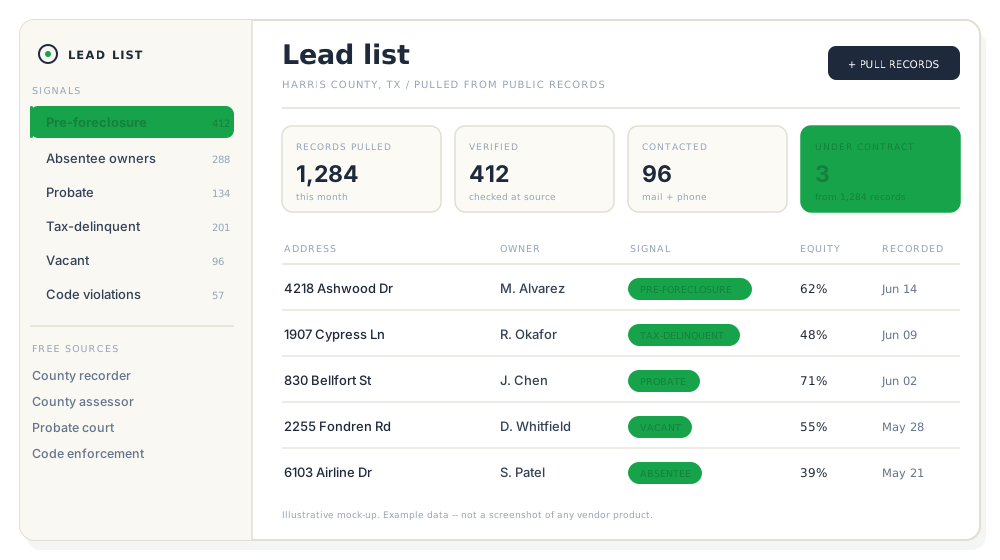
Notice the shape of the funnel. Records pulled is a big number. Under contract is a very small one. Anyone promising otherwise is selling something.
Where the signals actually come from
Every signal below is a document somebody filed at a government office, and almost all of them are free to search:
- County recorder / clerk — deeds, mortgages, notices of default, lis pendens filings.
- County assessor — ownership, mailing address vs situs address, assessed value.
- Probate court — estates moving through the court.
- Tax collector — delinquent tax rolls.
- Code enforcement — open violations.
- USPS vacancy data — addresses flagged as vacant.
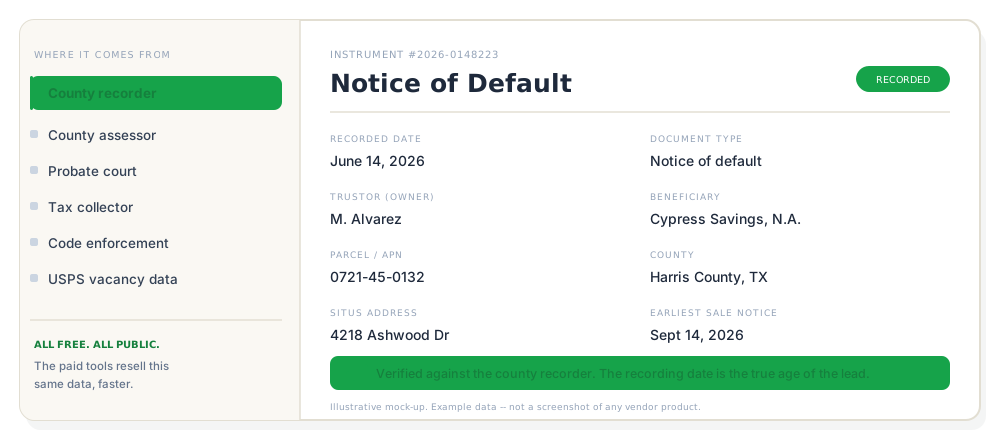
The single most important field on any of these records is the recording date. It is the true age of the lead. A data vendor’s “updated daily” badge means nothing if the filing it is showing you was recorded eleven weeks ago — an argument we make at length in where pre-foreclosure data comes from.
The six free methods
Each of these has its own walkthrough. Start with one, work it properly, then add another. Running six half-heartedly beats nothing, but running one well beats six.
- Pre-foreclosure filings — owners in default but not yet sold. The earliest, strongest signal. Method: where pre-foreclosure data comes from.
- Absentee owners — the mailing address differs from the property address. Often tired landlords.
- Probate leads — inherited property, heirs who would rather have cash than a house in another state.
- Tax-delinquent properties — owners behind on property taxes; a classic motivation signal.
- Vacant properties — no occupant, deferred maintenance, disengaged owner.
- Driving for dollars — the field method: spot distress in person, look up the owner of record.
Stack them and the picture sharpens. An absentee owner is a lead. An absentee owner who is also tax-delinquent and whose property is vacant is a conversation.
Reaching the owner — and whether that is even legal
Once you have an owner of record, you still need a way to reach them. Public records give you a mailing address; often it is stale. Skip tracing is how you find a current phone or address.
Then the question everyone asks: is it legal to contact homeowners directly? Broadly, yes — the records are public and direct mail to a property owner is ordinary commerce. The constraints are on how you reach them. Calls and texts are governed by the Telephone Consumer Protection Act, 47 U.S.C. 227, which restricts autodialed and prerecorded calls; federal and state Do Not Call rules apply; and some states regulate wholesaling itself. Compliance is the caller’s responsibility, not the data provider’s. Get advice for your state before you dial.
Free vs paid: where the tools earn their price
Every paid tool in this category — the data platforms, the driving-for-dollars apps, the skip-tracing services — is selling you the same public records, assembled faster and across more counties. That is a real product. It is not secret inventory.
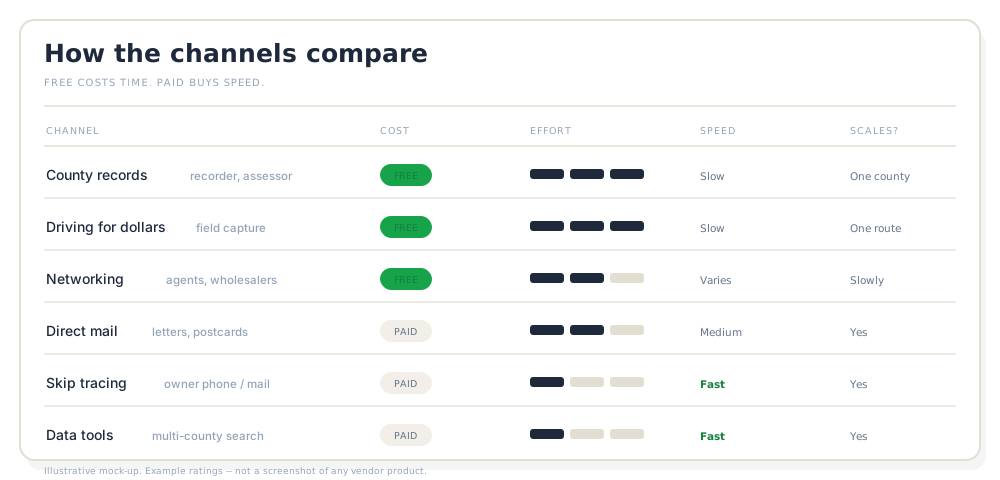
The honest line: free costs time, paid buys speed. Pull one county by hand and you will understand exactly what you are paying for when you eventually pay for it. When manual work stops scaling — multiple counties, weekly list refreshes, skip tracing at volume — that is the moment a tool is worth its subscription.
If you want a worked example of what one of those tools does and where it does not earn its price, our DealMachine review is structured desk research: what it does, what it costs, and where the free route is enough.
Verify before you spend a dollar
The discipline that separates this from list-buying is verification. Before you mail, call, or offer:
- Confirm the record at the county source, not the aggregator.
- Check the recording date against the vendor’s claimed freshness.
- Confirm the owner of record and the parcel.
- Check whether the equity is actually there.
That is the whole of our methodology: every claim traced to a primary source, dated. If a term above is unfamiliar, the glossary defines it in a sentence.
Are off-market properties actually cheaper?
Sometimes, and not for magical reasons. The discount, where it exists, comes from two things: no bidding war, and an owner whose motivation is worth more to them than the last few percent of price. Neither is guaranteed. Off-market does not mean underpriced — it means uncontested. You still have to run comps, estimate repairs, and hold your maximum allowable offer. A bad deal bought quietly is still a bad deal.
Sources
- NAR — new flexibility for sellers while retaining the Clear Cooperation Policy (Multiple Listing Options for Sellers; delayed marketing exempt listings; accessed July 2026)
- NAR — MLS Clear Cooperation Policy (one-business-day filing requirement; accessed July 2026)
- Cornell LII — Telephone Consumer Protection Act, 47 U.S.C. 227 (outreach restrictions; accessed July 2026)