
Custom Real Estate CRM: Build vs Buy
When a real estate team should build a custom CRM instead of buying one. Verified 2026 pricing, an honest cost model, and why most agents should hire nobody.
Most real estate agents should buy an off-the-shelf CRM and hire nobody. A custom build only makes sense for a narrow set of teams: those where per-seat pricing compounds across twenty or more seats, where the workflow genuinely fights the tool, where data ownership matters, or where a proprietary lead source has to integrate. If none of that is you, a $69/month subscription will beat a build every time.
On the conflict of interest, plainly: I build custom CRMs for money. That gives me an obvious incentive to make every off-the-shelf product below look inadequate. So here are the guardrails, and you should hold me to them. I earn nothing from any CRM named on this page — there is no CRM affiliate program on this site, no vendor pays for placement, and none of these links are commissioned. And I will tell you, in the plainest language I have, that most people reading this should not hire me. If that sentence is not in an article that ends in a pitch, close the tab. Our full disclosure is here.
Agents are not short of software
Before making the case for a CRM, look honestly at what agents already own.
In NAR’s 2025 REALTORS Technology Survey, 34% of Realtors spend $50 to $250 a month on technology, 20% spend $251 to $500, and 24% spend over $500 a month (NAR). Nearly a quarter of the profession is spending more than six thousand dollars a year on tools.
And the return? On the AI tools they bought, 46% report no noticeable impact on their business. Another 33% report only a moderately positive impact, and just 17% report a significantly positive one. A further 32% have not used them at all (NAR).
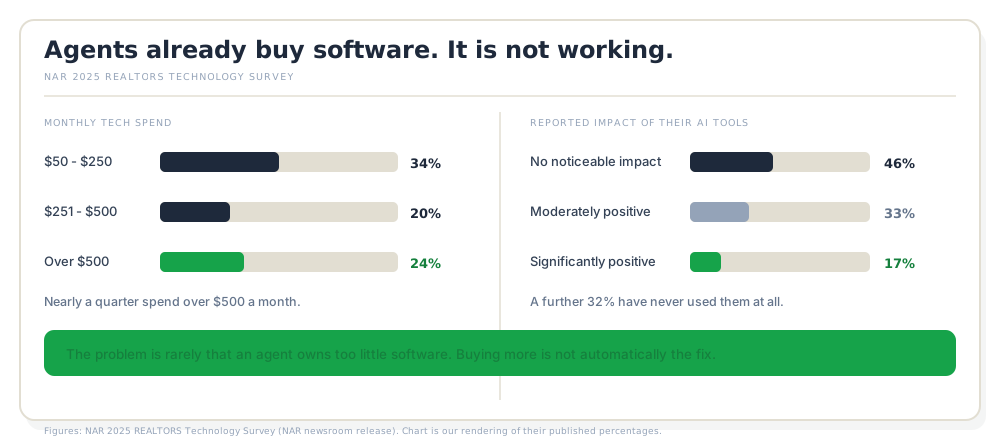
Sit with that before you buy anything else. The problem is rarely that an agent owns too little software. It is that the software they own is not connected to the way they actually work. Buying more is not automatically the fix, and neither is building more.
What a CRM actually does that a spreadsheet does not
The honest case for a CRM is narrow and it is real. It is not “organization.” It is this:
- It makes follow-up survive your memory. A deal dies in the gap between the third and the eleventh contact. A spreadsheet does not chase anyone; a CRM does.
- It gives you one database instead of six. Contacts in your phone, leads in a portal inbox, notes on paper, a spreadsheet you last opened in March. A CRM’s real product is that there is one place.
- It makes speed-to-lead a system rather than a virtue. Responding fast should not depend on whether you happened to see the notification.
If you are keeping fewer than a hundred relationships warm and closing what you can handle, a spreadsheet and a calendar are genuinely enough. Say that out loud before you spend anything.
What off-the-shelf actually costs
Verified at each vendor’s own pricing page, July 2026. I earn nothing from any of these.
| CRM | Entry price | Team pricing | Trial |
|---|---|---|---|
| Wise Agent | $49/mo, or $42/mo billed annually ($499/yr) | Base plan includes up to 5 team members; extra logins $20/mo; Enterprise custom at 15+ agents | 14 days |
| Follow Up Boss | $69/user/mo (Grow), or $58/user/mo annually | Pro: $499/mo including 10 users, then $49/user. Platform: $1,000/mo including 30 users, then $20/user | 7 days, no contract |
| BoldTrail (kvCORE) | Not published | Quote only — you must request a demo | Not advertised |
| Lofty | Not published | ”Request Pricing” on every tier (Agent, Team, Broker, Enterprise) | Not advertised |
Two things worth naming. First, at the entry level this is cheap: a solo agent can have a real CRM for well under $70 a month, and less than that from the budget tools. Second, two of the biggest team platforms will not tell you the price without a sales call. That is not a small thing. You cannot compare cost against a number you are not allowed to see, and opaque per-seat pricing is one of the few honest reasons teams start asking about a build.
For the full pricing picture across more vendors — including who refuses to publish a price at all, and what the real monthly cost is once add-ons stack — see our breakdown of what real estate CRMs actually cost.
Most agents should stop reading here
If you are a solo agent, or a team of three, buy Wise Agent or Follow Up Boss this week and go back to work. Do not hire a developer. Do not hire me.
The math is not close.
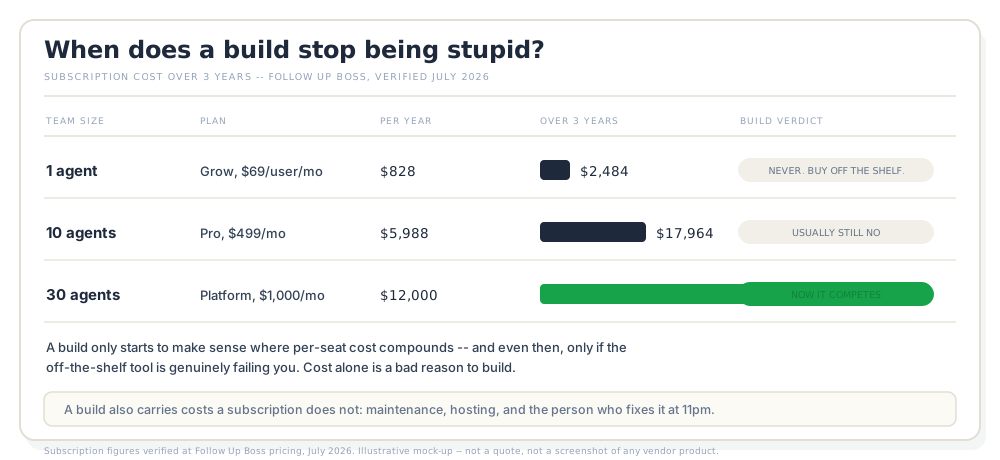
At Follow Up Boss’s verified rates, a solo agent on Grow pays $828 a year — about $2,484 over three years. No custom build recovers that. A ten-person team on Pro pays $5,988 a year, or roughly $17,964 over three years, and that still usually loses to buying.
It is at thirty seats on Platform — $12,000 a year, about $36,000 over three years — that a one-time build begins to compete on cost alone.
And even there, cost alone is a bad reason to build. A subscription is a price. A build is a price plus maintenance, hosting, and a person who fixes it when it breaks at eleven at night. If you build to save money and do not budget for that, you did not save money.
When a custom build actually pays
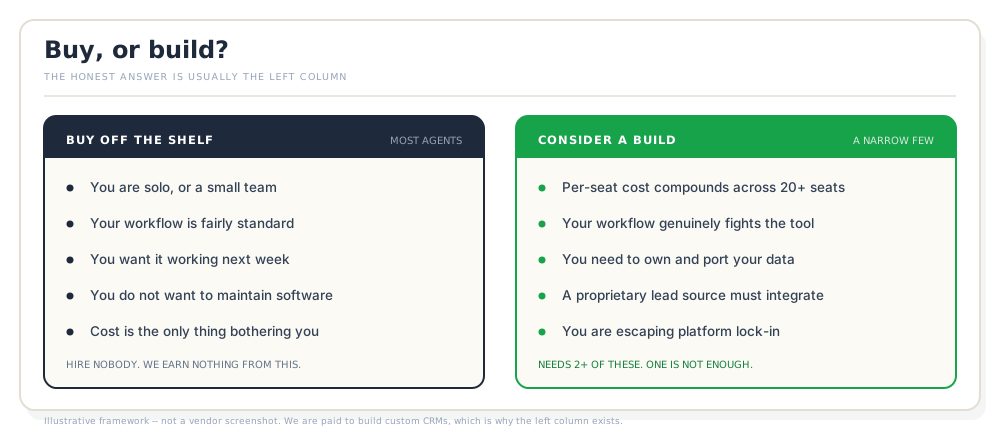
A build earns its keep when at least two of these are true. One alone is not enough.
- Per-seat pricing is compounding. Twenty, thirty, fifty agents. The subscription stops being a tool cost and starts being a headcount tax.
- Your workflow genuinely fights the tool. Not “I would prefer a different button.” A real structural mismatch: your team runs a process the software has no concept of, and every month you pay people to do manual work that exists only because the tool cannot model it.
- You need to own and port your data. If the answer to “what happens to our database if we leave” is unclear, you do not own your database. For a brokerage, that is a strategic exposure, not an inconvenience.
- A proprietary lead source has to integrate. You have a lead flow nobody else has, and the off-the-shelf integrations do not reach it.
- You are escaping lock-in. You are on a platform whose price you cannot see, whose roadmap you do not control, and whose export you do not trust.
If you read that list and recognised your brokerage in two or three lines of it, a build is a legitimate conversation. If you read it and recognised nothing, you have your answer and it costs $69 a month.
What I have actually built, and what I have not
I am an engineer. My training is in mechatronics; my doctoral research applied machine learning to large scientific datasets; and I have spent several years building AI systems and large-scale data pipelines — including property-data systems that reconcile millions of county records. Reconciling messy public-records data at scale is, structurally, the same problem as a real estate database that has to stay correct while five people write to it at once.
Now the part that most pitches leave out.
I do not have a portfolio of delivered real estate CRMs to show you. This is a new service line and I am taking a small number of projects. I am not going to invent case studies, and I am not going to show you testimonials that do not exist — the same standard we apply to every tool we cover on this site, applied to ourselves. What I can show you is how I work: verified against primary sources, dated, and open to inspection. That is the whole of our methodology, and it is why this article spends most of its length telling you not to hire anyone.
If you are the narrow case — a team where the per-seat math has turned, or a brokerage that cannot get its own data out — then email me at hello@offmarketlab.com and tell me what breaks. Not what you want built. What breaks. If the honest answer is that Follow Up Boss already solves it, I will tell you that, and it will cost you nothing.
If you are an agent thinking about how software finds you at all, our piece on answer engine optimization for real estate covers the other half of the problem.
Sources
- NAR — REALTORS embrace AI and digital tools (2025 Technology Survey) (tech spend brackets; reported AI impact; accessed July 2026)
- Follow Up Boss pricing (Grow, Pro, Platform; per-user rates; 14-day trial; verified July 2026)
- Wise Agent pricing (CRM and CRM + WiseSocial; annual rates; 14-day trial; verified July 2026)
- BoldTrail (kvCORE) demo and pricing (no public pricing; quote-based; verified July 2026)
- Lofty pricing (no public pricing; Request Pricing on all tiers; verified July 2026)