
How to Pull a Pre-Foreclosure List From County Records
The free method: which filing to search, which office holds it, and why your state's foreclosure path decides both. Statutes cited, verified July 2026.
A pre-foreclosure list is a list of public filings, and you can pull it yourself for free. Which document you search for depends entirely on your state: in non-judicial states the lender records a notice of default or notice of trustee sale with the county recorder; in judicial states the lender files a lis pendens or foreclosure complaint with the court. Both are public. Neither can legally exist until the loan is more than 120 days delinquent (CFPB, 12 CFR 1024.41(f)(1)(i), verified 2026-07-16).
We wrote about where pre-foreclosure data actually comes from and never delivered the how-to. This is it.
First, what the list actually is
A pre-foreclosure list is not a list of motivated sellers. It is a list of legal filings against properties. Some of those owners will sell. Most will cure the default, refinance, or be sold by the trustee without ever speaking to you. Every guide that calls this a “motivated seller list” is selling you a subscription.
Treat it as what it is: a dated, public signal that a specific property has entered a legal process with a clock attached.
The 120-day rule is why the list exists at all
Before you search anything, understand the timing, because it tells you how stale a filing is by the time you see it.
Federal rule: a servicer may not make the first foreclosure notice or filing unless “a borrower’s mortgage loan obligation is more than 120 days delinquent” (12 CFR 1024.41(f)(1)(i), verified 2026-07-16).
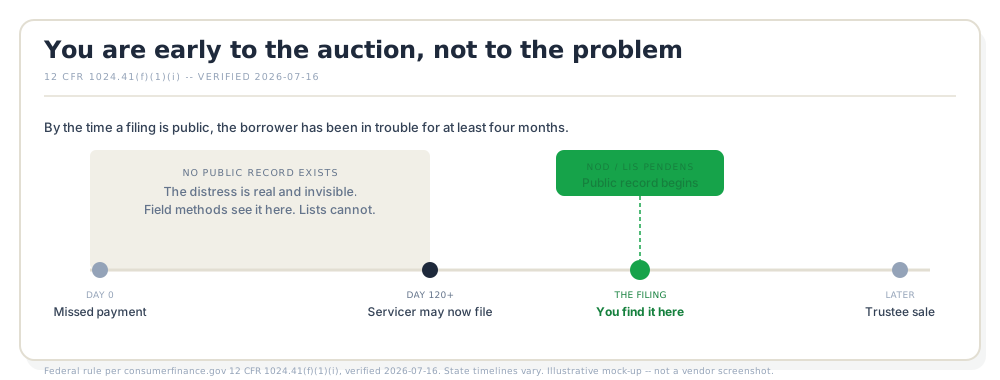
Two consequences worth sitting with:
- By the time a filing is public, the borrower has been in trouble for at least four months. You are not early. You are early relative to the auction, not to the problem.
- The filing is the starting gun, not the story. The distress began months before any record existed. That is why the field methods in how to find off-market properties still beat lists: they see the problem before the paperwork does.
Step 1: find out which path your state uses
This single fact decides which document you hunt and which office holds it. Get it wrong and you will search an empty database and conclude your county has no foreclosures.
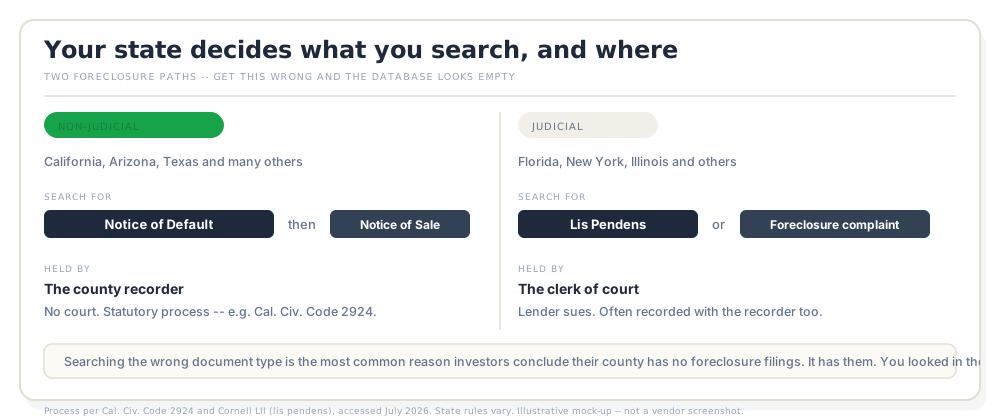
- Non-judicial states (California, Arizona, Texas and many others). The lender does not sue. It follows a statutory recording process. In California, that process is set out in Cal. Civ. Code 2924, which requires a recorded notice of default before a notice of sale. The record lives at the county recorder.
- Judicial states (Florida, New York, Illinois and others). The lender sues. The public marker is a lis pendens — literally “suit pending,” a recorded notice that litigation affecting title is underway (Cornell LII). The record lives in the court file, and often the recorder too.
If you do not know your state’s path, our definitional pages cover the vocabulary and the mechanics: pre-foreclosure, notice of default, and lis pendens.
Step 2: find your county’s official records search
There is no national database. There are roughly three thousand counties, and each one runs its own.
The search pattern that works: “[county name] [state] clerk official records search” or “[county name] recorder document search.” In judicial states, also try “[county] clerk of court case search.” You want the government domain, not the aggregator ads above it.
A word of honesty about what you will find: these portals are wildly inconsistent. Some let you filter by document type and date in three clicks. Some require an in-person visit. Some charge for copies while viewing stays free. And many actively restrict automated access — when we tried to load three county foreclosure portals on 2026-07-16 while researching this piece, one refused the connection, one failed to resolve, and one returned a 403. That is not a complaint. It is the single most important thing to understand about this market, and we come back to it below.
Step 3: search by document type and date
Once you are in the right portal, you are looking for a document type filter and a date range filter. Those two do almost all the work.
Search for, depending on your state:
- Notice of Default (NOD)
- Notice of Trustee Sale / Notice of Sale
- Lis Pendens
- Foreclosure complaint (court dockets, judicial states)
Set the date range tight — the last 30 days, then re-run it weekly. A filing from eight months ago has either cured or already sold. Freshness is the entire value of the list, and it decays fast.
Step 4: know what you are holding, and what is missing
The filing gives you a property, an owner of record, a lender, a date, and a legal clock. It does not give you:
- A phone number or email. Contact details are not in the filing. Getting them is skip tracing, and it is the one step that genuinely costs money.
- Condition. No filing tells you the roof is gone.
- Motivation. Plenty of owners in default are not selling, and some are actively hostile to the twenty investors who just mailed them.
- Freshness beyond the recording lag. Counties post on their own schedule.
The list is free. The aggregation is the product.
This is the honest answer to “why would I ever pay for this?”
You are not paying for secret data. Everything above is public and free, and any vendor implying otherwise is misleading you — that was the whole argument of our provenance piece.
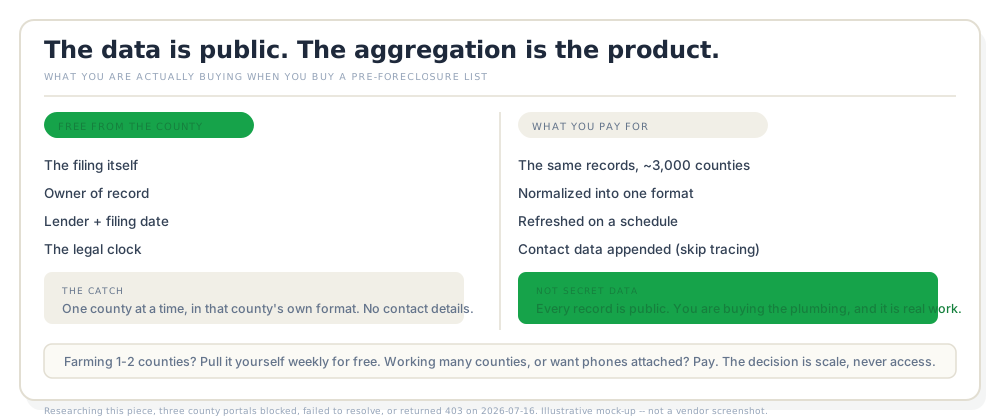
What you pay for is aggregation: the same public records, pulled from thousands of inconsistent county systems, normalized into one format, refreshed on a schedule, and joined to contact data. Having just watched three county portals block, fail and 403 in a single afternoon, we will say plainly that this is real work and it has real value.
So the decision is simple and it is about scale, not access:
- You farm one or two counties. Pull it yourself, weekly, for free. A subscription buys you almost nothing you cannot do in an hour.
- You work many counties, or you want contact data attached. Pay someone. Reconciling thousands of portals by hand is not a business, it is a hobby that eats your week.
If you land on the paid side, DealMachine starts at $119/mo, or $99/mo billed annually, and includes unlimited skip tracing on every plan, which is the unusual part — but its direct mail is metered and at real campaign volume the mail costs more than the subscription. We did the full arithmetic in our DealMachine pricing breakdown (verified 2026-07-16). DealMachine pays us a commission; our methodology explains why the verdict is written before the link.
The part nobody wants to hear
This list is public. That means every investor in your county can pull the same names on the same morning, and the good ones do.
Your edge is not the list. It never was. The edge is being faster, calling more, following up when the other nineteen mailers gave up after one postcard, and being the person who is decent to someone having the worst year of their life. The list is table stakes and it is free. What you do after you have it is the business.
Sources
- CFPB — 12 CFR 1024.41(f)(1)(i) (servicer may not make the first foreclosure notice or filing unless the obligation is more than 120 days delinquent; verified 2026-07-16)
- Cal. Civ. Code 2924 (non-judicial process; recorded notice of default precedes notice of sale; accessed July 2026)
- Cornell LII — lis pendens (recorded notice that litigation affecting title is pending; accessed July 2026)
- DealMachine help center — Starter plan and DealMachine pricing ($119/mo or $99/mo annually; unlimited skip tracing included; metered mail; verified 2026-07-16)
- County portal access: Harris County (TX), El Paso County (TX) and Maricopa County (AZ) foreclosure/recorder search endpoints were unreachable from our environment (connection refused, DNS failure, and HTTP 403 respectively) on 2026-07-16.